Jump to:
Here at Garden Buildings Direct, we’re strong advocates for why children need to play outdoors. An outdoor playhouse is one of the best resources that can encourage them to play in the garden and let their imaginations run wild.
This will cover everything from types of playhouses to building a base for one. It also goes into decorating ideas and basic upkeep. Ready?
How to Choose the Right Children’s Playhouse
Choosing a playhouse is fairly straightforward, and keeping these points in mind can help:
- How do your kids play, and what are their interests? This can influence your decision.
- Playhouses come in single-storey, two-storey, and tower-style designs.
- Weigh up your available space and budget.
- You need to build a suitable elevated base for your playhouse.
- Wooden playhouses are more durable and long-lasting than plastic ones. They can also be repainted and customised as your children grow. The downside is that they need a bit more maintenance.
- Some playhouses come in kits, allowing you to assemble them panel by panel, which makes things easier. Check for this feature when choosing a design.
What Are Playhouses?

A playhouse is a small garden building made for children to play in. They can be made of wood or plastic and come in single- or two-storey designs. Most have little windows, doors, and some have tiny porches. Basically, a house that’s pint-sized for pint-sized humans.
Learn the difference here:
What Are the Different Types of Playhouses
There are lots of styles to pick from to match their imagination.
Single-storey playhouses

If your children are younger, a smaller playhouse could be a good choice. You can never go wrong with the classic one-storey playhouse, like the BillyOh Lollipop Max. It’s simple and safe since there are no stairs or ladders to worry about.
The main drawback is that children can outgrow them, which shortens their usable life.
Best for: Small children and limited garden space.
Two-storey playhouses

A two-storey playhouse is one that’s split across two floors. They often feature an internal bunk on the second storey reached by a ladder. With some options, you can get a two-storey playhouse without a bunk. This can then accommodate older and taller children.
Like single-storey playhouses, they may either come with an apex or reverse apex roof and Georgian-style or shuttered windows. Windows on both levels mean that your children can get more sunlight and vitamin D and play throughout the day.
Our top pick:
Best for: Larger or more adventurous children.
Tower playhouses

A tower playhouse is elevated off the ground on stilts. Children access the playhouse via an external ladder onto a small balcony to enjoy a great view from up top.
Tower playhouses are very popular as they also provide space underneath. You can use this for toy storage, as a shaded play area, or even as a garage! Tower playhouses are excellent choices for growing and more adventurous children.
You can find versions of this style as tower playhouses with a slide or even swing sets. (Plus, it can give kids a place to play that parents can’t easily access!)
Our top picks:
Best for: Growing, adventurous, and active children.
Wendy houses

The world was first introduced to Wendy houses after J.M. Barrie’s Peter Pan. And since then, our little ones haven’t looked back. Essentially, it’s just another name for a small playhouse.
The classic look is that of an apex-roof single-storey playhouse. You might also find a Wendy house with a platform and picket fence to extend the play area, along with a gate.
Best for: A timeless look and indoor and outdoor play.
Cottage playhouses and cubby playhouses
Again, just more names for Wendy house or playhouse. Featuring a traditional design that often includes barn doors, flower boxes, picket fences and traditional crossed windows. Can be either one storey or two stories.
Best for: Kids with green thumbs.
Now that you know the options, let’s look at the why before we get to the how.
Why Buy a Playhouse?
This might be your first time asking this question. If not, you’ll know that we’re big supporters of playhouses for kids.
But it’s not just our opinion—playhouses can:
- Reduce screen time
- Be used year-round, rain or shine
- Provide a dedicated space for play
- Include projects like growing plants in planters
- Offer health benefits by getting kids out in the fresh air and sunshine
- Help children take responsibility for their own space, encouraging independence
The benefits of a playhouse go beyond fun. A garden playhouse is not only a great place to play, but it can also support social skills and imaginative thinking.
How Can Playhouses Be Used?

Playhouses can be used in many ways, depending on your children’s interests and imagination. Some families turn theirs into a space station, superhero HQ, a mini kitchen, or a fairytale cottage.
Want ideas? Check out our playhouse decor ideas for inspiration on themes, storage hacks, and seasonal styling.
Choosing a Playhouse (Checklist)
Yes, there’s more to think about, including:
- Size and height: How big are your children, and how much will they grow?
- Usage: How often will the playhouse be used, and how long do you want to keep it?
- Safety: We’ll cover this in more detail, but make sure your playhouse is EN71-certified.
- Roof type: Usually apex or reverse apex, which gives more headspace.
- Design features: Are you keen on a picket fence or barn doors?
- Extras: Would your kids enjoy a slide or a ladder?
- Available space: Consider your garden or courtyard.
- Planning permission: We’ll go into this in more detail shortly.
1. Size and height
You’ll need to consider not just your children’s size and height, but the playhouse itself.
If you want something they can grow into, a two-storey playhouse or one with an apex roof might be the best choice. A taller playhouse also gives you more room for extras like overhead storage shelves.
Balance your budget with the other factors on this list, and pick the largest playhouse you can reasonably afford.
Not sure what size suits your child’s age and height? Check out our guide to playhouse sizes to compare internal heights, door sizes, and more.
2. Usage
How often and for what you plan to use the playhouse should factor into your decision. For something cheap and cheerful, a plastic playhouse might do the trick.
But if your children are the type to play outside for hours at a time, you’ll want a playhouse that’s durable. Also, consider how weather-resistant it is. For instance, wooden playhouses can be treated to protect them against the elements, while plastic playhouses don’t have parts that can rot.
3. Safety
With usage comes the question of safety. If you’re worried about very small children falling, you might want to skip a tower playhouse. That said, even tower playhouses often come with features like anti-slip ladders.
For any children’s playhouse, make sure it meets all Garden Buildings Direct safety standards, including:
- EN71-certified
- Glazed windows made from shatterproof styrene
- Safety hinges on doors
- 12mm gaps around doors for little fingers
- Non-slip ladders
- Certified for ages 36 months+
- Smoothed and planed timber
On top of these features, it’s a good idea to have an adult supervise playhouse use. Or, at least make sure the playhouse is visible from the main house.
Safety is an ongoing commitment, not just a one-time box to tick at purchase. Once your playhouse is up and in regular use, it’s worth knowing the signs of wear to watch for — things like loose ladder fixings, splinters on weathered timber, or windows nudging out of their frames. Read our guide on common hazards in kids’ Wendy houses to stay ahead of the issues that UK weather and active play can cause over time.
4. Roof type
Your playhouse’s roof type will factor into the question of size and aesthetics. The main options on offer include:
- Pent roof: Where the roof is one single plane that slopes to the back of the shed to maximise runoff
- Apex roof: Made of two slopes that meet at the highest point in the middle. Slopes fall to either side of the playhouse face
- Reverse apex: Similar to an apex roof, but slopes fall towards the front and back of the shed
- Dutch barn: Made of four sloping panels that create a smoother apex-style roof
Consider which roof will give you the most headspace for growing children.
5. Design features
As well as the main style of playhouse that you choose (e.g. tower, Wendy house, two-storey, etc.), what design features excite you and your kids?
Do you want traditional-looking Georgian or crossed windows? This may well play into the theme of your playhouse that we discussed earlier. If you want to make a classic fairytale cabin, then a quaint playhouse with a picket fence might be the best choice.
6. Extras
Once you’ve settled on the general style of the playhouse you’d like, think about extras. If your children are particularly boisterous, then the addition of slides, swings, and ladders might be in order.
7. Where to put a playhouse?
When picking a playhouse (or any garden building), you need to be realistic. Sure, you might want a luxury two-storey log cabin playhouse, but think about:
- Safety: Is your proposed playhouse site near any dangers like nettles or a ditch?
- Level ground: Building a suitable base for a wooden playhouse can extend its life. But it’ll require level ground.
- Surrounding space: Is there enough room to access all around the playhouse?
- Drainage: Make sure to build where there is sufficient drainage. Avoid marshy ground or buildings at the bottom of a slope.
- Trees: Will trees block sunlight and put your children off playing in summer? Do trees pose a danger with falling fruit or branches?
- Supervision and visibility: Is your playhouse in the line of sight of the house? Can you get to it easily and quickly if need be?
Tip: Find a spot in your garden with space to create a level base. Leave room around your playhouse to access it for maintenance. (Or to allow children to run around it!).
8. Planning permission for a playhouse
You might be wondering: Do I need planning permission for a playhouse?
In most cases, the answer is no. Playhouses usually fall under ‘permitted development,’ so permission isn’t needed. Certain locations will always need planning permission to construct any kind of garden outbuilding, or may have some other restrictions applied.
As long as your playhouse doesn’t take up more than 50% of your outdoor space and you don’t put it in the front garden, you shouldn’t need planning permission. It’s still a good idea to check with your local council, and a quick chat with your neighbours is a polite move.
Some playhouses have raised platforms, which can require planning permission. This immediately impacts two-storey and tower playhouses. Any structure with a platform more than 30cm high requires planning permission (because, in theory, it could impact your neighbours). There have been cases where families were ordered to remove playhouses and climbing frames because of this rule, where they hadn’t obtained planning permission. Your best bet is to check with your council before you buy.
We’ve got a full guide that explains all the planning permission technicalities that affect playhouses, including which regions have different rules.
Planning Permission for Outdoor Playhouses
If you want to get the most out of your playhouse, you could consider adding electricity. This opens up the potential for their own little TV corner, adding music, or giving it some lighting. However, proper electrical setup with underground cabling involves hiring an electrician and is a lot more costly than running an extension cord across the lawn.
Now that you’ve seen the options and decided on the material and style that suit you, buying a playhouse from Garden Buildings Direct couldn’t be simpler. Pick your style, customise it as you like, and follow the easy-to-assemble tongue-and-groove panels when it arrives.
To give you an idea of what to expect, let’s take a look at:


Building a Playhouse
If you want to, you can check out the post we wrote about building your own playhouse. But for now, we’ll just assume you want to know how to assemble the playhouse that you’ve bought.
If you purchased your playhouse from Garden Buildings Direct, your assembly instructions will have been included with your order confirmation.
To follow these, you will need:
- Some good weather (a clear day)
- A friend to help out
- A couple of hours of free time
- A rubber mallet or hammer
- Drill or screwdriver and screws
- Staley knife
- Step ladder
You’ll also want to make sure you have a suitable base for your children’s playhouse. Building straight onto the ground isn’t advised. This is because moisture from the earth can cause rising damp and rot to your playhouse floor.
Instead, check out our post on how to build a shed base. You can replicate this for your playhouse. Options include either building on a concrete slab or pavers, or laying down a timber sub-floor or gravel and plastic foundation base.
Make sure to build on as close to level ground as possible. Also, allow for adequate drainage and try to raise your playhouse off the ground.
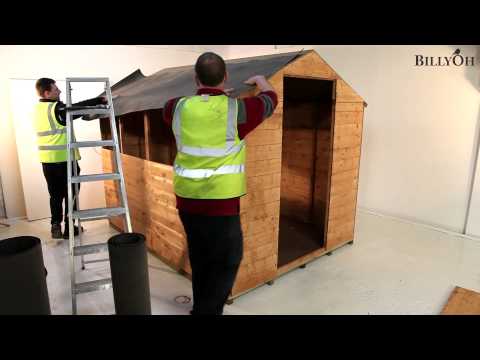
Check that all your parts are there. Once you’ve done that, fit together the tongue and groove panels of your wooden playhouse, starting with the walls at the back. Between the two of you, you should be able to build your playhouse in a matter of hours.
To see how easy this process is, check out the video below:
Playhouse Maintenance
And once you’ve picked, bought, and assembled your playhouse, you can start to get prepared for further down the line. Namely, treating and decorating it.
Treating and painting your wooden playhouse
Preservative-based treatment on the timber will protect your playhouse against insects and rot. Pressure treatment is the gold standard for this, as it provides rot-preventing protection from the manufacturing stage. Otherwise, you will need to paint or stain your playhouse separately with a wood treatment, though this then needs topping up yearly.
This is because wood can either rot in damp and cold weather or dry out and crack in warm weather.
But essentially, sanding (where necessary), priming, and treating timber can help extend its life. Just remember to use a transparent sealer if you plan to paint over it. Use a coloured wood stain if you want a traditional, rustic look.
And always use EN71-certified or water-based paint if you’re painting your playhouse interior.
Playhouse will also typically have gaps where windows and doors are for safety precautions. We wouldn’t recommend it, but to make your playhouse more insulated and weather-proof, you might consider caulking around these gaps. That’s if you accept the associated responsibilities and trust your children!
A better way to achieve a similar goal might be to try adding a silicone sealant along the grooves of the roof. This way, you will keep the safety measures intact.
Cleaning your playhouse
This might all seem like a lot, but further down the line, you’ll also need to clean your playhouse.
For a plastic playhouse, this is fairly simple and is one of their biggest selling points. Simply wash the outside either with a hose, pressure washer, or a soft-bristle brush and some soapy water. The last method can be used on the interior as well.
Make sure to clean debris and bird droppings as these can leech the colour from your plastic playhouse.
For wooden and plastic playhouses, sweep out the interiors to get rid of any leaves that might have blown in, as well as dust and cobwebs. You could even check out some of our cleaning and maintenance tips.
We suggest a natural solution of either vinegar or bicarbonate of soda and water in a spray bottle for cleaning playhouse interiors. Make sure to aerate your playhouse sufficiently and keep kids out of it till it’s done. This is a lot safer and smarter than using chemical sprays where your children play.
And there you have. We’ve taken you from explaining what a playhouse is to looking into the future. We can just see it now, you and the whole family having a whale of a time in your brand new two-storey playhouse space station.
So, I guess it’s time to answer the big question:
Are Playhouses Worth It?
We’ve weighed in elsewhere on whether it’s worth building your own playhouse, but is it worth getting one at all?
From our point of view, the answer is a resounding yes. A playhouse can:
- Offer opportunities for year-round play
- Allow children to play in any weather
- Provide a high-quality garden building made from durable materials
- Be a purchase you can trust, with precise fittings
- Be treated to last for years
- Be customised to suit changing themes as your children grow
- Support your children’s development
Make sure to follow our guide to choose the playhouse style that suits your budget, available space, and other needs. Plan ahead with a wooden playhouse that your kids can grow into, not out of. The rest is up to you!
If you like, you can also check out our guide on how to prepare your garden for a new outdoor building.
A quick comparison:
| Playhouse Type | Best For | Product Examples |
|---|---|---|
| Single-storey | Toddlers, safety, compact gardens | Lollipop Max, Lollipop Junior |
| Two-storey | Older children, long-term value | Peardrop Extra |
| Tower | Adventurous play, added features | Lollipop Max Tower, Lollipop Junior Tower |
| Cottage/Wendy Style | Traditional look, flexible themes | Peardrop Extra, Lollipop Max |
FAQs
How to make a playhouse myself?
Your Garden Buildings Direct playhouse requires a minimum of two people and some tools to help assemble it. Following the assembly instructions provided with your order, it should only take a matter of hours to build.
What size should a playhouse be?
You want to make sure to purchase a playhouse that your kids won’t quickly outgrow. If they’re taller, perhaps they need a two-storey playhouse. Make sure to try and maintain a scale that encourages them to use it without feeling overwhelmed.
A good way to do this is to mark out your proposed playhouse site before purchase with some strings lines. Adjust these until you find a size that your children are comfortable with.
Can you put a Wendy house on grass?
We’d advise against placing any garden building straight onto the ground as it can cause damp and uneven pressure on the structure. However, you can build a level gravel and plastic foundation onto grass or a timber sub-floor to elevate your playhouse.
How long does a playhouse last?
Most wooden playhouses will come with a 10-year anti-rot guarantee. Regular wood treatment can help to extend the lifespan of your playhouse.
What makes a good playhouse?
What makes a good playhouse objectively could be things like:
- Durability
- Quality of construction materials
- Ease-of-assembly
- Weather-resistant
But you’ll also need to factor in what makes a good playhouse for you, including:
- Suitability for your available space
- How the aesthetic fits in with the rest of your garden
- How it suits your children’s ages, size, and style of play
What age are playhouses for?
Our playhouses are not designed for children aged under 36 months. This is because there are small parts that may be a potential choking hazard. The maximum user weight for tower and two-storey playhouses is also 50kg. We recommend keeping playhouses a minimum of 2m clear from any obstructions or other structures.