Jump to:
Greenhouses aren’t exceptions when it comes to needing a base, but their requirements differ from sheds and other garden buildings. Here’s the rundown to make a good greenhouse base.
Does a Greenhouse Need a Base?
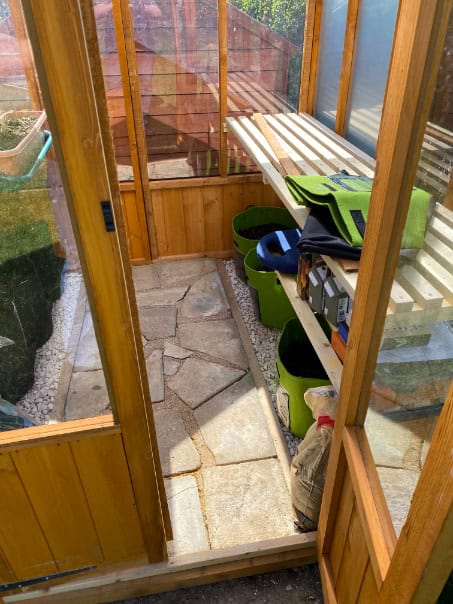
Yes, but it doesn’t have to be a full foundation embedded into the soil. A flat, stable surface that supports the frame and covers its entire footprint is enough. Besides structural stability, the goal is to prevent water from pooling underneath.
What Are the Best Greenhouse Base Types
There are four common options, and these are:
Concrete pads
Concrete pads are flat, horizontal surfaces made from poured concrete, masonry blocks, or smaller pre-cast slabs. They are stable, long-lasting, and a good choice if your greenhouse will be a permanent structure in the garden.
Timber frame with gravel
Pressure-treated timber is often used to make the frame wherein the gravel will be poured. It’s lightweight and easier to install, does the job in draining water, and is perfect for small to medium greenhouses or uneven ground.
Paving slabs
Mostly made from concrete, paving slabs are thicker and stronger than regular garden stones. They can work as a greenhouse base without the need to pour a full concrete slab, as long as they’re laid on a level, compacted surface.
Compacted gravel
This base is made by laying small, crushed stones in layers, wetting them, and using a plate compactor to lock the pieces together. The material is good for drainage and is best for larger greenhouses.
How to Anchor Your Greenhouse
Most greenhouses have large, flat panels, and they act like a giant sail. A base isn’t just there to keep your greenhouse flat; its most important job is to hold the structure down. If a greenhouse isn’t securely anchored to its base, a strong gust of wind can easily lift, twist, or completely blow it away, destroying the frame and shattering the glass or panels.
Here is how to anchor your greenhouse based on the surface you chose:
- Use the base plinth: Most quality metal greenhouse kits come with (or offer) a galvanised steel base plinth. This is a sturdy metal frame that acts as an intermediary between your greenhouse and the ground. Always build this first, anchor it to your base, and then bolt the greenhouse frame directly to it.
- Anchoring to concrete or paving slabs: This is the most secure method. Drill holes through the bottom lip of your greenhouse frame (or base plinth) and use heavy-duty expansion bolts (rawl bolts) to secure it directly into the solid concrete or thick paving slabs.
- Anchoring to a timber frame: If you built a heavy, pressure-treated timber border for a gravel base, you can use heavy-duty wood lag screws to bolt the metal greenhouse frame directly into the heavy wood.
- Anchoring in gravel: If your base is strictly compacted gravel, you cannot bolt into the loose stones. Instead, you must use deep ground anchors (sometimes called earth augers or soil anchors). These corkscrews deep into the solid earth beneath the gravel layer and bolt to the corners of the greenhouse frame to firmly lock it down.
How to Prevent Water Pooling in a Greenhouse
The location of your greenhouse plays a major role. Even the strongest base can fail if water finds its way to collect underneath. Here’s what you can do:
- Avoid dips or low spots where rain or watering runoff can pool.
- Add a small raised edge or a gravel layer under the base to encourage natural drainage.
- Make sure gutters and downpipes direct water away from the structure.
Good drainage goes hand in hand with a proper base; it not only protects the structure but also helps your plants flourish.
Round-up
Choose a greenhouse base based on the structure size, your garden space, and budget. Then work on keeping water moving away to make the building last longer and easier to manage.
On the hunt for a new greenhouse? Check out our available quality options below. The base isn’t included, but that means you can match it with any type you like for a perfect fit.
FAQs
Can I use a greenhouse on grass without a base?
It’s possible, but not recommended. Grass alone is uneven and shifts over time, causing the greenhouse to wobble or water to pool under. Paving slabs or compacted gravel will stabilise it and improve drainage.
At what level does the greenhouse base need to be?
The rule of thumb is to be completely level across the greenhouse footprint. Even a small slope can affect the frame, doors, and water flow. This is where a spirit level comes in handy.
Can I move my greenhouse later if I use a permanent base?
Greenhouses on permanent bases, like concrete pads, are much harder to relocate. Consider a lightweight base option such as timber with gravel or paving slabs for a temporary setup.
If the concrete base is already in place, this guide can help: How to Remove a Concrete Shed Base
Does the type of base affect plant growth inside the greenhouse?
Indirectly, yes. A stable base plus proper drainage support healthier soil conditions, which helps plants thrive.
Do I need to insulate or cover the base?
Not usually needed. However, in colder climates, you can add insulation when preparing the base or use raised boards to protect roots from frost and reduce heat loss inside the greenhouse.