Jump to:
A timber playhouse is weather-resistant rather than weatherproof. It is built to shed water and then dry out again, not to be closed up airtight. That distinction matters, because the most common mistake owners make is trying to seal the building shut — running caulk or expanding foam into the joints — which causes more damage than the draught it was meant to stop.
What actually keeps a kids’ playhouse dry is the roof and the base. What slows biological decay in the timber is a surface treatment, applied to every face and kept up over the years. Those are two separate jobs, and neither one is gap-filling. Here is how to do both.
What Actually Keeps a Playhouse Dry
Two things do most of the work, and neither involves a tube of sealant.
The roof covering
- The covering sheds the rain, not the boards underneath. Roofing felt or shingles is the weathering layer. The roof boards behind it are not designed to take direct rain.
- Check the overlaps run the right way. Each sheet or course should lap over the one below it, so water runs across the joint and off the roof rather than into it. On an apex roof the ridge piece goes on last, covering both slopes.
- Give the covering a drip edge. The felt or shingles should carry slightly past the roof boards at the eaves and verges, so water drips clear instead of tracking back along the underside and onto the wall panels. Fascia and barge trims hold that edge down.
- The covering wears out before the timber does. Inspect it every year for splits, tears around nail heads, lifted edges and damage at the ridge. A failed roof puts water into the structure far faster than any gap in the cladding, so repair or replace it as soon as you spot it.
- Keep it clear. Sweep off leaves and debris. Anything that sits and holds water against the covering shortens its life.
The base
- Keep the building off wet ground. A playhouse sitting straight on soil or grass draws water up through the bearers and floor. The floor underside is usually the first part to decay.
- Use a level, free-draining base. Concrete, paving slabs or a timber-framed base on firm ground all work, provided water drains away from it rather than pooling under the building.
- Leave the walls clear. Don’t bank soil, bark or planting up against the cladding. Keep a gap of at least a few hundred millimetres so air moves round the building and splashback can drain.
- Check it sits level. A building standing out of level can bind its door and windows, and low corners collect water.
Treat the Timber Before or During Assembly
The timber is European spruce. Its resistance to rot and fungal decay comes from treatment, and the time to apply that treatment is while the panels are still separate and can be laid flat — not once the playhouse is standing.
Once the building is up, several surfaces are out of reach for good:
- Panel backs and inside faces — the faces that end up hidden behind framing, trims and corner joints.
- The floor underside — the surface closest to the damp ground and the hardest one to get at later.
- Cut ends and end grain — end grain takes up water much faster than a face does, so any factory cut end, and anything you trim on site, wants a coat before it goes in.
- Board edges — including the tongues and grooves, and the underlaps on overlap cladding.
A few practical points while you work:
- Lay panels flat on trestles or battens so you can reach both faces, and let each coat dry for the time the manufacturer states before you handle or fix them.
- Mask the window openings. Playhouse glazing is styrene, not glass, and some coatings will mark plastics — check the label before letting anything touch it.
- Treat again after cutting. If you shorten a board during assembly, the fresh end is bare timber.
On guarantee cover: a spray-treated or tongue-and-groove building carries a 10-year anti-rot guarantee, and a pressure-treated building carries a 15-year anti-rot guarantee. In both cases the cover is for rot and fungal decay, not the whole building. Check which applies to your model, and read the terms for what upkeep is expected of you.
Ongoing Treatment and the Annual Check
Surface treatment is consumed by weather and sunlight, so it needs renewing. How often depends on the product and how exposed the building is — follow the recoating interval on the tin, and expect south- and west-facing walls, and anything in an open or coastal spot, to need it sooner than the label’s middle estimate.
Signs a recoat is due:
- Colour has faded, gone patchy or looks chalky.
- Rain darkens the timber quickly instead of beading and running off.
- The finish is flaking, lifting or peeling anywhere.
Once a year, ideally at the end of winter, walk round the building and check:
- Roof — splits, tears at fixings, lifted edges, loose trims.
- Base and floor — soft spots underfoot, a damp underside, water standing beneath the building.
- Cladding — splits, cupped boards, or boards that have slipped out of their groove or overlap.
- Fixings and ironmongery — rust, loose hinges, latches that no longer close.
- Windows — styrene panels sitting firmly in their beading, trims intact.
- Ventilation — vents clear, and doors and windows opened on dry days so the inside can dry out.
Before you recoat, brush the panels down with a soft brush, wash off grime with warm soapy water, and let the timber dry right through. Then apply thin coats rather than one heavy one, which gives more even coverage and fewer runs.
One thing not to act on: gaps that open in dry weather and close again in damp weather. That is the cladding accommodating seasonal movement, and it is doing what it was designed to do.
Choosing a Coating for a Children’s Playhouse
A playhouse is a product children touch, lean on and chew the edges of, so the coating choice is narrower than it would be on a shed.
- Child-safe and toy-safety-compliant. Look for a product that states compliance with the toy safety standard for coatings — BS EN 71-3, which covers the migration of certain elements. If a tin doesn’t say so, treat that as a reason to pick a different one.
- Water-based and low-VOC. Less solvent odour while you apply it, easier clean-up, and water-based exterior treatments are typically more permeable than solvent film varnishes, so timber can still dry outwards.
- Exterior grade, with pigment. Sunlight breaks down surface coatings, and a pigmented product weathers more slowly than a clear one.
- Allow the full cure, not just dry-to-touch. Those are different stages. Keep children out of and off the building until the manufacturer’s stated cure time has passed, and leave it ventilated while it cures.
- Match the coating to the paint, if you are painting. What improves paint adhesion is a primer or basecoat intended for that paint — not a finish coat underneath it. A cured varnish or oil finish gives paint less to grip, and oil-based finishes and water-based acrylic paint are poorly compatible, so acrylic applied over cured oil is liable to lift.
- Try it somewhere low first. An offcut or a hidden panel tells you the colour and coverage before the whole building is committed.
Two products worth being careful with:
- Polyurethane varnish. It is a film-forming varnish and contains no biocide, so it is not a preservative and does nothing about rot or mildew on its own. While the film is intact it resists moisture. Once the film cracks or lifts, water gets behind it and dries out more slowly than bare treated timber would, which makes decay worse rather than better.
- Raw linseed oil. It offers no fungicide, and the oil itself can support mould growth on the surface. Oil-soaked rags are also a fire risk: they can self-heat as the oil cures. If you want an oil finish, choose an exterior-grade product that includes a fungicide, and lay rags out flat outdoors to dry, or put them in water in a sealed metal tin, before disposing of them.
Why Not to Use Filler, Caulk or Expanding Foam
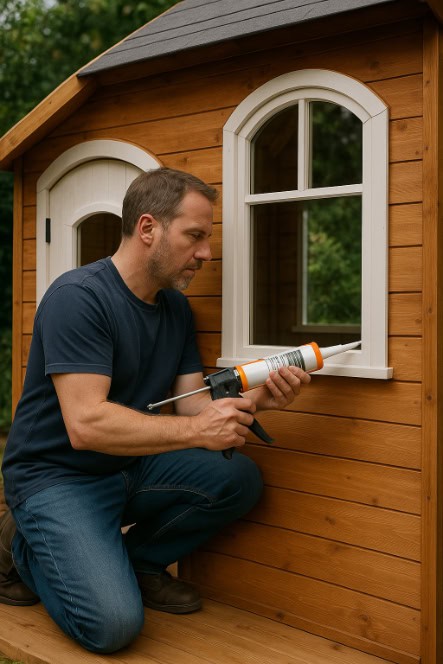
Our position is straightforward: don’t apply filler, caulk or expanding foam to a timber garden building. Three reasons.
- The building is designed to move. Overlap and tongue-and-groove cladding lets boards expand and contract with the seasons by sliding against each other. Bond those joints together with a rigid filler and the movement has nowhere to go, so it comes out as cupped and split boards. Rigid sealing causes the damage it is supposed to stop.
- Filled gaps trap moisture inside. A timber building needs to dry outwards. Close off the joints and damp that gets in stays in, against the timber, which is where decay starts.
- Expanding foam is a poor outdoor material. It is not UV-stable, it absorbs and holds water against the timber, and it degrades into crumbs. On a building children use, loose crumbs are a concern in their own right.
If water is actually getting in, the cause is almost always the roof covering, the base, a board that has slipped out of its groove, or a loose trim. Fix the cause. Where wind-driven rain hits a particular joint, an external timber cover strip or corner trim — fixed on one side only, so the panels behind it can still move — will shed the water without gluing the joint shut.
Round-up
Weather protection on a timber playhouse comes down to five things: a sound roof covering with proper overlaps and a drip edge; a level, free-draining base that keeps the building off wet ground; treatment on every face, including cut ends, panel backs and the floor underside, applied before or during assembly; a child-safe, water-based coating renewed on the manufacturer’s interval and left to cure fully; and an annual look over the roof, base, cladding and fixings. Leave the joints unfilled — the movement they allow is part of how the building works.
Looking for the right garden retreat for your kids? Our range of playhouses with slides is always a hit with the kids. For enquiries, give us a ring on 01909 768840.
Next read: The Complete Playhouse FAQ – All Your Questions Answered!