Jump to:
Garden offices have soared in popularity over the last decade. When you’re working from home, taking your setup into the garden provides crucial physical separation for distraction-free productivity and a healthier work-life balance.
But what kind of building should you actually use? Is a standard garden shed going to fit the bill, or do you need a purpose-built room? As experts in garden buildings for over 25 years, we’ve seen every type of conversion imaginable. Here is our honest breakdown of what works, what doesn’t, and what you need to know before you buy.
Is my shed good enough to use as a garden office?
If you have a solidly built brick shed, it might already be suitable to convert into an office. But if you are looking at standard timber, metal, or plastic sheds, you need to manage your expectations.
The ideal garden office requires three non-negotiables:
- Ventilation
- A safe, professional electrical supply
- Thermal insulation
Most standard sheds are built for storage, not habitation. Metal and plastic sheds often come with ventilation pre-installed, but they are the worst offenders when it comes to insulation. They will shield you from wind and rain, but they act like a freezer in the winter and an oven in the summer—hardly a comfortable workspace for a 9-to-5 day.
As for wooden sheds, they are marginally better insulated. However, they are typically made from thin cladding (usually 11mm to 15mm). If your main goal is storing lawnmowers, bikes, and tools, a heavy-duty wooden garden shed is exactly what you need. But if you try to work in one, the heat from your electric heater will escape straight through the walls, leaving you shivering in your coat.
Expert Warning: The Insurance Risk
Beyond temperature, there is a security reality. Standard sheds are not designed to house £2,000 worth of laptops and monitors. Most rely on a basic hasp and staple for a padlock. In contrast, log cabins and insulated rooms come with superior cylinder or mortice locks. Many UK home insurance policies will not cover expensive electronics left overnight in a single-skin shed.
Do Log Cabins make good Garden Offices?
An office log cabin is a highly attractive option, but you need to be selective about the specifications. To ensure the space is usable, look for models equipped with opening double-glazed windows, which solve your ventilation needs while trapping heat.
When it comes to timber insulation, thicker is always better. To guarantee a comfortable workspace, you should be looking at a 44mm thick timber log cabin as a minimum. For enhanced security and warmth, look for models where the windows and doors can be upgraded to uPVC.
Bear in mind that timber is a natural product and will expand and contract with the UK weather. This can lead to minor gaps, so be prepared to maintain the building with temporary sealant. (Check out our guide to dealing with gaps in your log cabin).
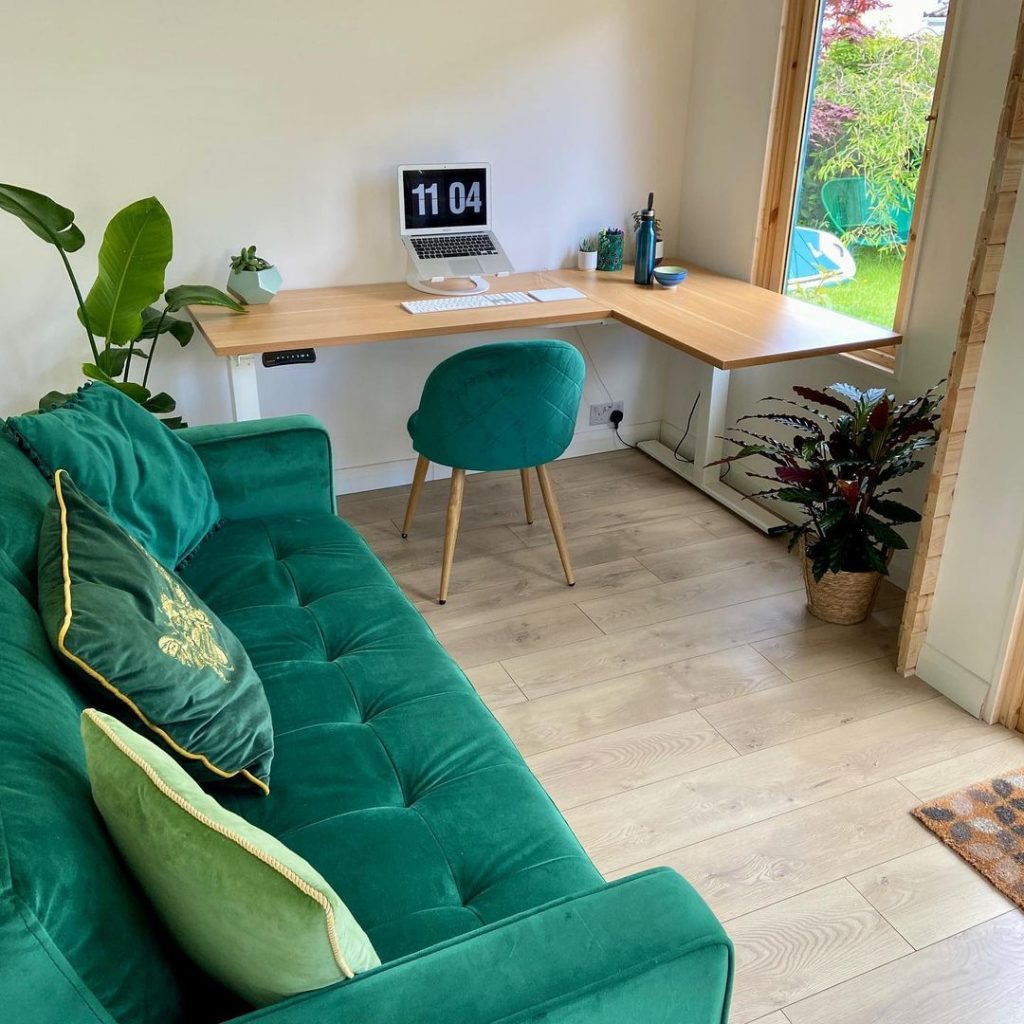
Even with these upgrades, it’s important to be honest: standard log cabins aren’t usually rated for 365-day use. Our experts recommend them more as a writer’s study or a spring-to-autumn workspace rather than a full-time winter office.
The best option: an Insulated Garden Room
If you require a truly permanent, professional workspace every day of the year, an insulated garden room is the ultimate choice. These buildings are specifically engineered to mimic the thermal efficiency of a modern house.
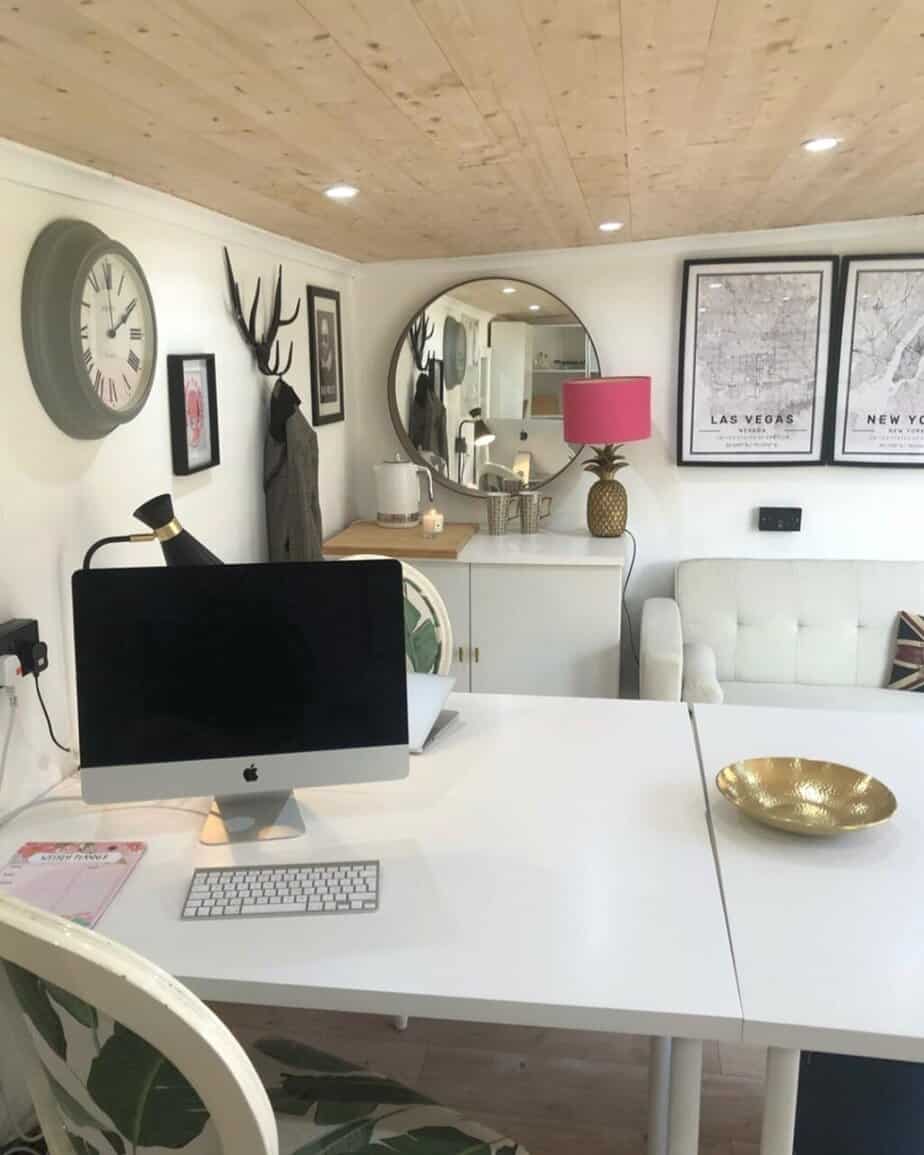
The gold standard for these premium buildings is SIP (Structural Insulated Panel) construction. To understand the difference, we look at “U-values,” which measure how easily heat passes through a material. The lower the U-value, the better the insulation:
- A standard single-skin wooden shed has a U-value of roughly 3.0 W/m²K.
- A high-quality SIP panel garden room can achieve U-values of around 0.18 to 0.25 W/m²K.
This level of thermal resistance rivals modern building regulations for actual home extensions. In the summer, that same insulation works in reverse, preventing the sun from turning your office into a greenhouse. If you are still weighing up your options, our comprehensive garden room buying guide explains the different specifications in more detail.
Crucially, high-grade insulation prevents the rapid temperature fluctuations that cause condensation. This means your electronics and paperwork are completely safe from overnight dampness—a massive risk in an uninsulated shed.
Conclusion: What Makes the Best Office Shed?
Attempting to turn a standard shed into a home office is a tempting way to save money, but it usually results in a workspace that is too cold, too hot, or too damp for professional use.
Ultimately, your choice comes down to your budget and working schedule:
- For occasional summer use: A traditional timber summerhouse provides a beautiful, breezy space for reading or light laptop work.
- For a 10-month workspace: A double-glazed 44mm cabin offers the perfect middle ground, providing natural timber insulation and proper door locks.
- For a permanent, year-round office: A fully insulated SIP panel workspace is the only option that guarantees 9-to-5 comfort in any weather.
Whichever route you choose, establishing a solid, level base and installing a safe electrical supply are your first steps. If you are ready to upgrade your work-from-home setup, explore our ranges today or reach out to our team for expert advice.