Jump to:
Before you commit to a business in a garden office, one of the things you need to know is whether it’s tax-deductible. The short answer is that it can be, but there are important caveats and restrictions. In this guide, we’ll break down what you can claim, how much, and under what conditions. But remember, these are general guidelines and it’s always best to consult with a tax professional for your specific situation.
Can I Claim My Garden Office as a Business Expense?
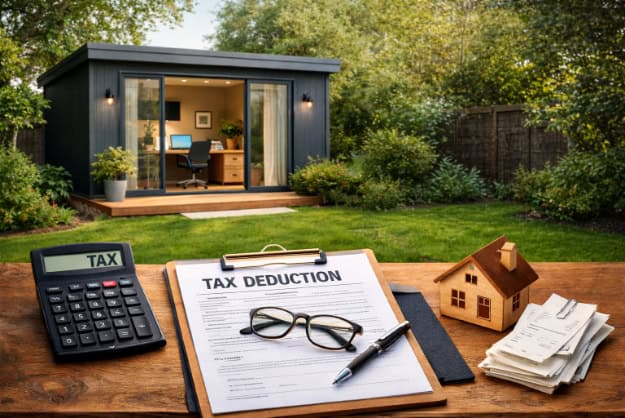
You can’t claim the building as a business expense. But you can claim a portion of the costs related to running it. This could include a desk, office chair, computer, phone line, or internet access.
Say you earn £10,000 from your home business, and the desk and chair cost £500. You can “deduct” that £500 from your earnings, so your taxable profit becomes £9,500 instead of £10,000.
Is a Garden Office Tax-Deductible if I Only Work from Home?
No, it’s not tax-deductible because, if you’re just an employee and not running a business, the expenses are considered personal. Furniture, electricity, or internet in this context are viewed as personal spending. Thus, they can’t reduce your taxable income.
However, there is a small tax relief for employees required to work from home.
Is the Cost of Building a Garden Office Tax-Deductible?
The garden office building is not tax-deductible if you’re working from home as an employee. In that case, expenses like furniture, electricity, and internet are considered personal, so they can’t reduce your taxable income.
However, if you’re self-employed, there may be tax relief for some of the items which go into operating your garden office.
As mentioned, the rules only allow you to deduct items or equipment used for running your own business. These can also be treated as a capital allowance. Meaning you can spread the cost over a few years rather than claiming it all at once.
You can’t claim the full cost of building a garden office as a business expense. Since it’s considered a building within the residential curtilage, it doesn’t qualify for the Structures and Buildings Allowance (SBA) capital allowance.
How Do I Calculate the Tax-Deductible Portion of a Garden Office?
You work out the deductible part by looking at how much of the office you use for business. Check the floor space it takes up, the hours you spend working there, or the electricity bill.
For instance, if your office is about 10% of your home’s total space, you could claim roughly 10% of the relevant costs. Keep your calculations reasonable and jot down the numbers to make it easier to keep track and explain if anyone asks.
Are All Garden Offices Tax-Deductible?
No, not all garden offices can be claimed on your taxes. Having a garden office doesn’t automatically make it a business expense. Only the part of the office that is used for business counts, and any personal use reduces what you can claim.
We recommend keeping your calculations fair and reasonable. Splitting costs based on time used for work, floor space, or bills helps make it clear which expenses relate to your business.
Will a Garden Office Increase My Council Tax?
No, using a garden office for business doesn’t affect your council tax. The only time council tax changes is if the office is converted into a livable space. For instance, adding a kitchen, bathroom, or sleeping area. If it’s purely as a workspace for meetings, computers, or paperwork, your council tax will stay the same.
Always check with your local council, especially if you’ve made big changes to the building. You can also refer to our guide below, where we debunk common myths:
[Garden Shed Tax – The Truth About Council Tax on Garden Buildings in the UK]
However, you may have to pay business rates on top of council tax if there are customers or employees visiting the property.
Do I Need Planning Permission for a Garden Office?
It depends. Most small garden offices don’t need planning permission because they fall under permitted development. However, size, height, and where you place it in your garden all matter. If your office is larger than the allowed limits, too tall, or in a restricted area, you’ll need to apply for planning permission before building.
Learn more:
[Log Cabin Planning Permission: What You Need to Know]
Round-up
A garden office can be a great addition to your home business. Knowing what counts for tax purposes helps you plan wisely, and we hope this guide helps you do so. But remember, this shouldn’t be a substitute for professional advice.
Chat with an accountant or a tax professional. They can help you work out exactly what you can claim and make sure your calculations are accurate.
Ready to shop? Browse our quality selections below: